
EN71-1 Version 2026: What Changed in the New Toy Safety Standard?
The new edition of EN 71-1 2026 is here. It covers the mechanical and physical properties of toys and replaces the 2014 edition together with its 2018 amendment. If you are toy manufacturer, supplier or third party testing institution for the European market,, this is the standard your products are measured against.
1. Why the EN 71-1 2026 Edition Matters
CEN approved the standard on 14 December 2025, and it carries a January 2026 date. National standards bodies have until July 2026 to adopt it. After that, conflicting national standards must be withdrawn by July 2027.
The scope has not changed. The tests have several EN 71-1 test methods have been rewritten, and some are completely new.
2. The Largest Change: Toys That Carry a Child
Ride-on toys, bicycles, balance bikes and scooters now sit in one place. Clause 8.21 gathers every test for toys that bear a child’s mass into eleven subclauses. Five of them are new:
– Handlebar end impact. Each end of the handlebar is struck against a hard surface ten times.
– Brake performance. Brakes are now judged against force tables instead of a simple distance measurement. Input forces of 40 N, 50 N and 60 N are applied step by step.
– Handlebar stem security .A torque of 10 N·m is held for one minute.
– Stabilizer strength. A 300 N load is placed on each stabilizer wheel. Deflection must stay within 25 mm and permanent set within 15 mm.
– Saddle and seat-post security. A vertical load of 200 N is placed on the saddle.
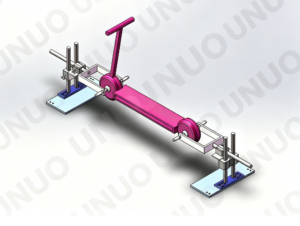
(Handlebar End Impact Tester)
3. Other Test Changes Worth Knowing
- Expanding materials (8.14) has been rewritten from the ground up. The method now soaks the sample for 72 hours in deionised water at 37 °C and uses a PTFE gauge. A material passes if it loses mechanical cohesion, or expands by no more than 50 %, or passes completely through the gauge.
- Escape force (8.42) is new. A child inside an enclosed toy must be able to open the closure using no more than 50 N.
- Ventilation openings (8.43) is also new. It uses a template to measure groups of openings. Two positions at least 150 mm apart, each giving 1 300 mm² of open area, are accepted.
- Projectiles (8.23) now measures both kinetic energy and kinetic energy density. The number of shots has risen from five to ten, and the measuring distance tolerance has tightened to ±1 mm.
- The soaking test (8.9) uses water at 21 °C instead of 20 °C, while the timing steps now carry tolerance bands.
- Food-imitating toys (4.28) brings a new requirement. Toys that look like real food must not contain any part that fits entirely inside the small parts cylinder.
Smaller clarifications matter too. The drop test may now run in random orientations if the worst position cannot be identified, and the compression disc must lie flat against the toy surface.
4. What This Means for Your Lab
Every new method needs the right instrument behind it. Torque and tension testers, drop test rigs, impact and compression testers, small parts cylinders, sharp edge and sharp point testers, stability platforms, brake benches and sound level systems all see updated use under the new edition.
At UNUO INSTRUMENTS, we supply toy testing equipment for laboratories and factories doing toy safety testing.
Make your quality visible — talk to our team about your EN 71-1 setup.