

EN 362:2004 Clause 5.4 Explained: Gate Resistance Tests for Connectors | Unuo
People who work at height trust their lives to small metal parts. Snap hooks, scaffold hooks and carabiners connect the harness to the anchor, the rope and the shock absorber. One part of a hook works harder than most people notice. It is the gate, the spring arm that opens and closes.
A gate has a rough life on site. It is dragged over steel beams, pinched inside scaffolding and struck by dropped tools. If the gate bends, cracks or pops open at the wrong moment, the hook can let go and the worker can fall. When a hook fails, the result can be fatal, so every part of it must stay strong in every direction it can be pulled.
EN 362:2004 Clause 5.4 exists to stop this. It sets out two tests that press on the gate and measure how much force it can take. A hook may carry the CE mark only after its gate passes them.
1. What EN 362:2004 Clause 5.4 Checks
On any hook, the solid spine is the strong part. The gate is the weak point, because it must move. A hinge pin and a spring hold it, and a hard push can bend or break it. In the lab, the gate is loaded until the force named in the standard is reached, and the tester watches what happens. The two loads act on the gate from different directions, because on a real site a hook can be caught from the front or knocked from the side.
[Hook spine, one solid piece] <—> [Gate and latch, the moving weak part]
The clause splits the check into two tests:
- Gate face test (5.4.1). A steel ram pushes the closed gate from the front, in the direction that would force it open inward.
- Gate side test (5.4.2). A steel ram presses against the gate’s outer edge.
2. Who Uses These Tests
Four groups work with this clause:
- Hook makers. A forging or stamping factory must pass the test before its connectors may carry the CE mark.
- Brands and OEM buyers. Companies that import gear must get proper test certificates from the factory. The papers protect a brand from recalls and legal claims.
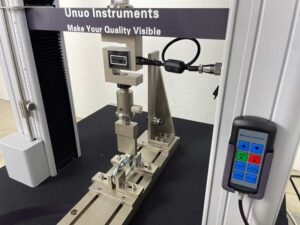
- Test labs and QC engineers. They run the checks with a universal testing machine, steel holding blocks and force sensors.
- Site safety officers. They ask for EN 362 test proof before a hook goes to a worker, so the gear meets European safety law.
3. How the Test Is Done
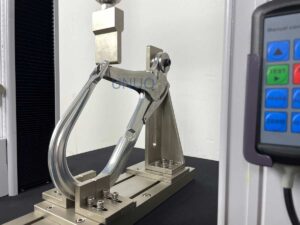
Every test runs on a new, unused hook. This rule sits in clause 5.2.2 of the standard. The lab locks the sample in steel blocks on a universal testing machine. The load rises slowly and evenly, at 50 to 150 newtons per second. There is no sudden hit.
Part one: the gate face test (5.4.1)
Step 1. Clamp the hook so the gate points straight up.
Step 2. Put a small steel pin just above the gate’s latch nose.
Step 3. Drive the pin down at a steady 50 to 150 N per second until the sensor reads 1 kN. That equals a weight of roughly 100 kg.
Step 4. Keep the 1 kN load on for 90 seconds, as the standard asks.
Step 5. Watch the gate under load. It must not give way inward, and it must not pull more than 1 mm away from the latch nose.
Step 6. Take the load off. Open the gate with one hand. The spring must snap it shut and lock it fully, with no sticking.
Part two: the gate side test (5.4.2)
Step 1. Turn the hook on its side and clamp it, with the gate’s outer wall up.
Step 2. Press a flat steel pin onto the gate latch from the side.
Step 3. Raise the load at a steady 50 to 150 N per second until the reading climbs to 1.5 kN. That equals roughly 150 kg of sideways force.
Step 4. Hold the load for 60 seconds.
Step 5. Check the metal. It must not snap, crack or show any visible damage.
Step 6. Take the load off. The gate must still open and lock freely, just as it did at the start.
4. Common Questions
4.1 Why does a hook fail the face test?
It fails when the gate cracks or breaks, when it moves more than 1 mm from the latch nose, or when the spring jams after the load is removed. A factory that sees a failure usually moves to a better grade of steel, or thickens the gate wall.
4.2 Do screw links (class Q) need this test?
No. A screw link, also called a quick link, closes with a threaded steel sleeve. It has no spring latch and no moving gate arm, so EN 362 says Clause 5.4 does not apply to class Q. Connectors of classes A, B, M and T have spring gates and must pass.
4.3 What equipment does the lab need?
A universal testing machine with speed control of 50 to 150 N per second, an accurate force sensor, and steel fixtures shaped to hold different hooks. The fixtures must grip the hook tightly so it does not turn while the load is applied.
4.4 EN 362 or ANSI Z359.12: which gate test is harder?
The US rule is far tougher on gates. EN 362 asks 1 kN on the gate face and 1.5 kN on the gate side. ANSI Z359.12 asks 3,600 lbf (16 kN) in both directions.
4.5 Can a tested hook go back into service?
No. Even a hook that passes has been loaded at 1 kN or 1.5 kN, close to its limit, and the metal holds stress inside. Tested samples should be destroyed so they can never reach a job site.
UNUO INSTRUMENTS supplies the testing machines labs use for checks like this. MAKE YOUR QUALITY VISIBLE.